A fully illustrated, video-guided, milestone-based journey through all aspects of yoga โ asana, pranayama, meditation, and philosophy.
Before diving in, here are the key methods to verify your form without a teacher present.
Set up your phone to record your practice. Compare your form against the illustrations and videos provided in each phase below.
Position your mat beside a full-length mirror. Check alignment in real-time โ are your joints stacked? Is your spine neutral?
If you can breathe deeply and steadily in a pose, your alignment is likely good. If you're holding your breath, you've gone too far.
Discomfort in muscles = normal stretch. Sharp pain in joints = misalignment. Always back off if you feel joint pain.
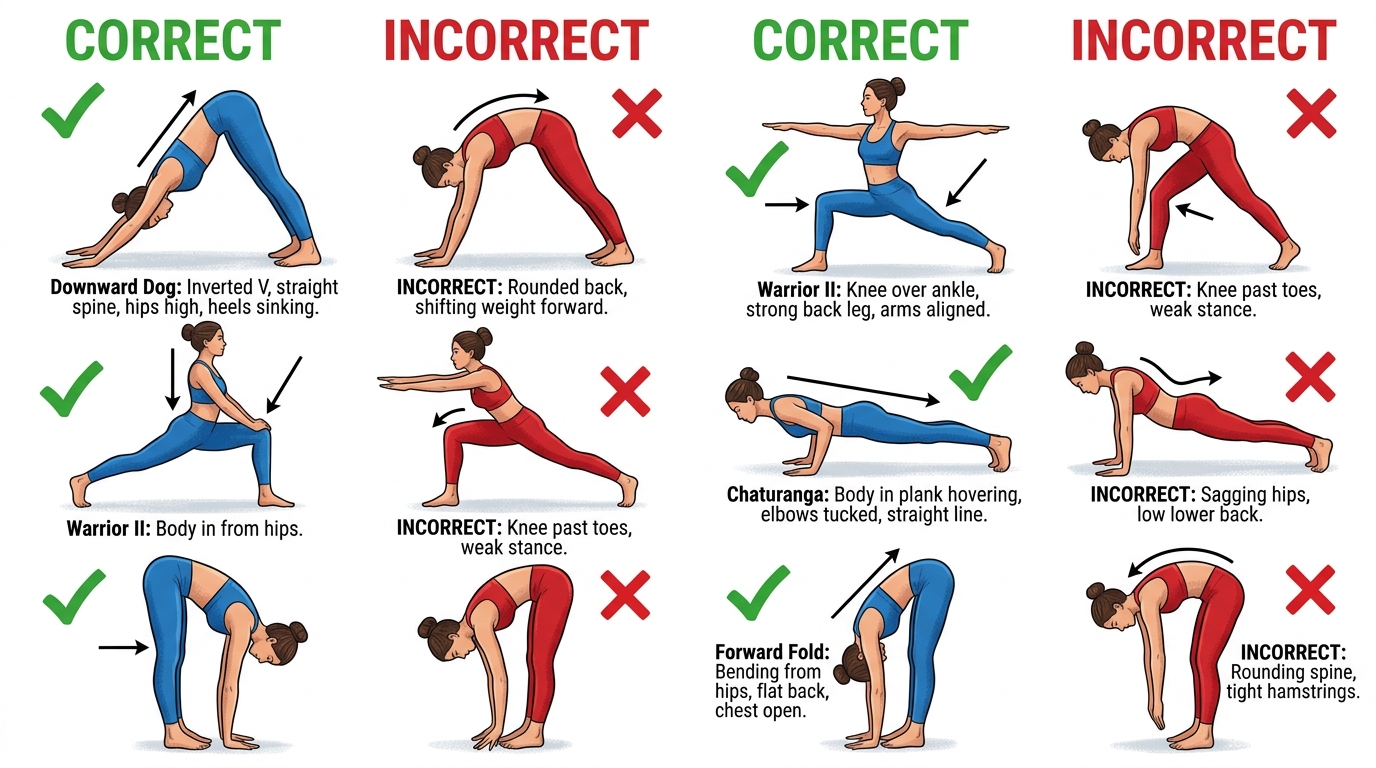
Study these common alignment mistakes so you can self-correct during practice.
Our entire curriculum is built on the clinical kinesiology, breathing mechanics, and skeletal variance principles established by Leslie Kaminoff and Amy Matthews in their landmark textbook, Yoga Anatomy (Human Kinetics):
Core Teaching: Respiration is fundamentally a three-dimensional shape change between two fluid-filled compartments: the thoracic cavity and the abdominal cavity, bounded by the diaphragm.
Core Teaching: The respiratory diaphragm's right and left crura anchor directly onto the upper lumbar vertebrae (L1โL3), sharing a continuous anatomical fascial connection with the Psoas Major.
Core Teaching: Poses are not static shapes; they are dynamic balance points between working stabilizers (concentric/isometric) and lengthening tissues (eccentric release).
Core Teaching: Kaminoff's foundational axiom: "Never sacrifice the individual for the sake of the pose." Human bone structure governs unique joint angles for every practitioner.
Click any phase to jump directly to its detailed plan with illustrations and videos.
Basic poses, breath awareness, habit building
BeginnerSun Salutations, Vinyasa flow, core strength
Beginner+Inversions, arm balances, meditation
IntermediateHandstands, deep backbends, personal practice
AdvancedSubtle body, advanced pranayama, philosophy
Advanced+Teacher training, specialization, lifelong mastery
ExpertMonths 0โ3 ยท 3โ4x/week ยท 20โ30 min sessions
Goal: Build body awareness, learn basic alignment, establish a consistent practice habit.
What completing Phase 1 permanently reprograms in your body, brain, and longevity biomarkers:
Reverses chronic anterior pelvic tilt and "desk slump" kyphosis. Decompresses the L4-S1 lumbar discs and rehydrates dry spinal cartilage through passive axial traction.
Diaphragmatic and Ujjayi breathing stimulates the afferent vagus nerve, rapidly lowering baseline morning cortisol and down-regulating sympathetic fight-or-flight triggers.
Multi-planar gentle movement circulates synovial fluid into hip, knee, and shoulder capsules, arresting age-related cartilage thinning and morning joint stiffness.
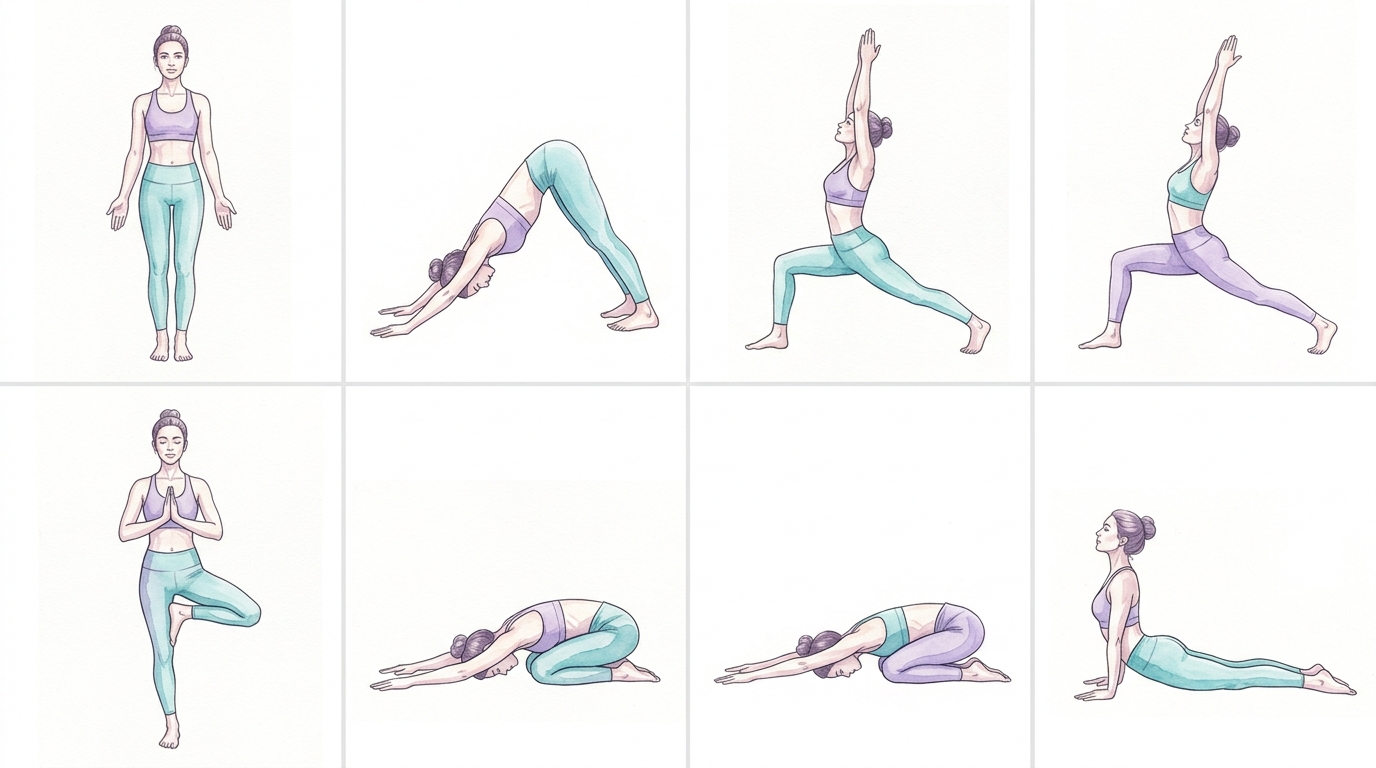
Study each pose carefully. These 8 poses are the building blocks of your entire yoga journey.
Tadasana
Adho Mukha Svanasana
Virabhadrasana I
Virabhadrasana II
Vrksasana
Balasana
Bhujangasana
Watch these carefully chosen tutorials to see each pose in action and learn proper form.
The #1 most-watched beginner yoga video. Perfect 20-minute introduction covering all foundational poses.
20 minDeep breakdown of Warrior I, II, and III with detailed alignment cues you can follow along with.
17 minDetailed alignment tutorial for the single most important pose in yoga. Learn why and how to do it right.
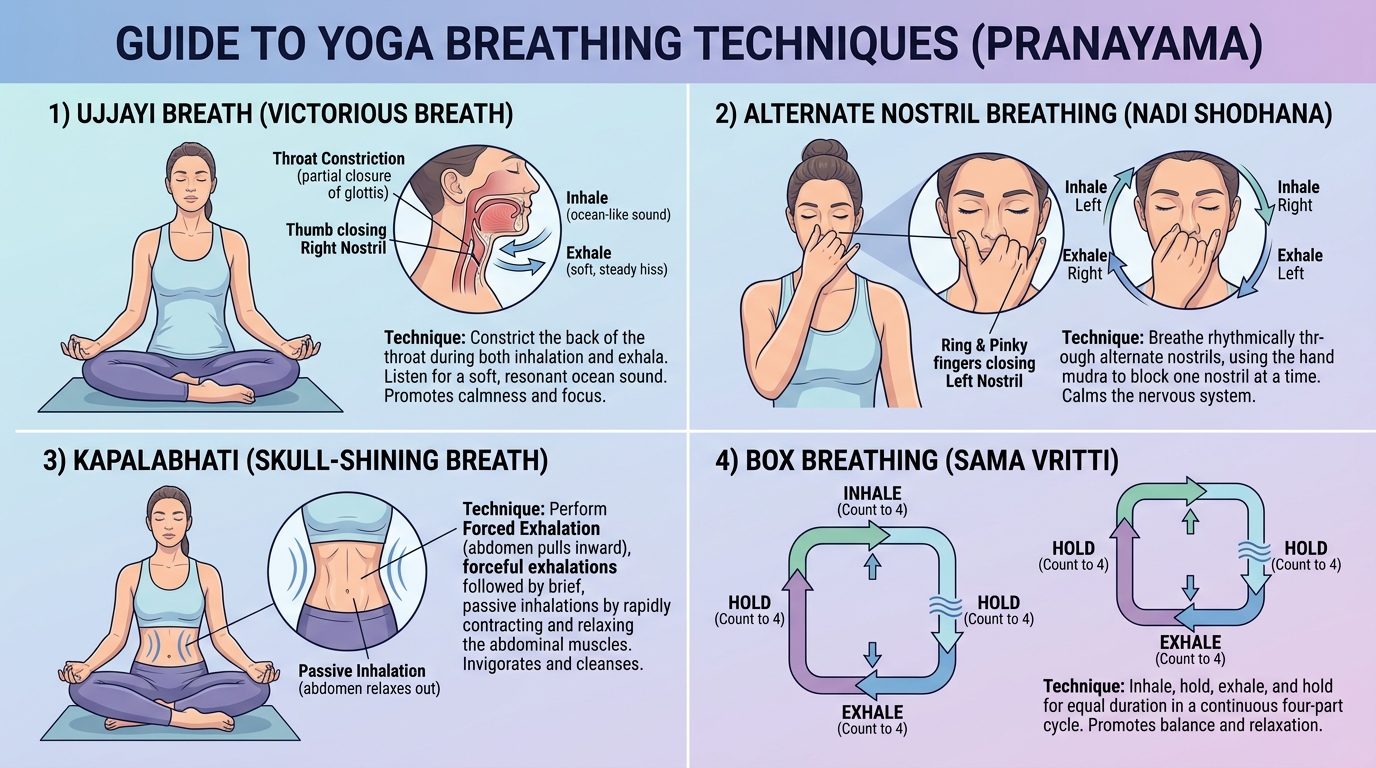
7 minLearn Ujjayi (ocean) breathing and diaphragmatic breathing. The foundation of all yoga practice.
5 min
Place one hand on chest, one on belly. Breathe so only the belly hand moves. Practice 5 min daily.
Slight throat constriction creating a soft "ocean" sound. Like fogging a mirror, but with mouth closed.
Inhale 4 counts, exhale 4 counts. Gradually increase to 6, then 8 counts.
Focus on habit formation and joint mobilization. Learn diaphragmatic breath and get comfortable on the mat without forcing flexibility. Consistency over intensity.
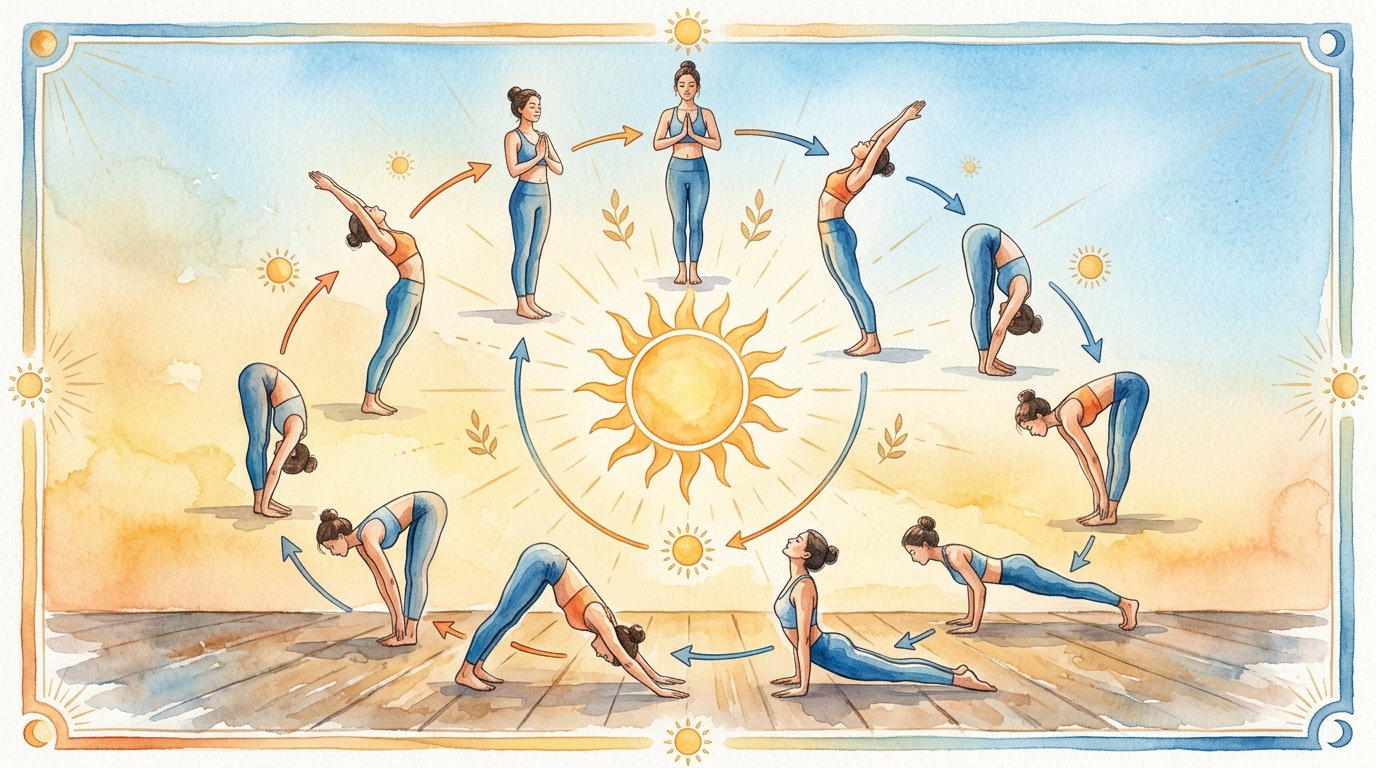
Introduce Surya Namaskar A step-by-step. Link movement to Ujjayi breathing. Begin holding foundational standing postures for 5 smooth, full breaths.
Consolidate balance in Tree Pose and strength in Downward Dog. Lengthen sessions to 30โ35 minutes. Establish a dedicated morning or evening yoga space.
Check these off as you achieve them. Your progress is saved locally.
Months 3โ6 ยท 4โ5x/week ยท 30โ45 min sessions
Goal: Deepen foundational poses, introduce Sun Salutations as a flow, build core and upper body strength.
What consistent Vinyasa practice and Sun Salutations permanently build in your physiology:
Dynamic isometric transitions (Chaturanga, Plank, Warrior III) forge a muscular weight belt through the transverse abdominis, protecting against future lumbar disc herniations.
Linking breath to movement (Vinyasa) expands vital lung capacity by 15โ20% while conditioning the cardiovascular system without high-impact joint pounding.
Continuous large-muscle contractions across standing poses deplete glycogen safely, improving insulin receptor sensitivity and optimizing resting blood glucose regulation.
This is the single most important sequence in yoga. Master this before anything else.
10 consecutive rounds of Surya Namaskar A match the cardiovascular expenditure of 20 minutes of moderate aerobic exercise, enhancing arterial elasticity and lowering resting blood pressure over time.
Alternating between deep spinal extension and full forward fold acts as an internal hydraulic pump, clearing cellular waste, boosting lymphatic circulation, and strengthening systemic immunity.
Morning sun salutation synchronization resets circadian cortisol and melatonin curves, banishing brain fog upon waking and inducing deeper, more restorative REM sleep at night.
The more athletic cousin of Salutation A: it adds Chair Pose and Warrior I, which build leg strength and heat quickly. Master A first, then move at the same breath-per-posture rhythm.
Virabhadrasana III
Phalakasana
Eka Pada Rajakapotasana
Navasana
Step-by-step Sun Salutation with detailed alignment for each transition. Follow along and memorize the sequence.
15 minYour first full vinyasa class. Builds on Sun Salutations with standing poses woven into flowing sequences.
30 minBuild the core strength needed for arm balances and inversions in later phases. Boat Pose, Plank, and more.
22 minLearn this powerful breathing technique that balances the nervous system. Practice daily for 5โ10 minutes.
6 minRapid, forceful rhythmic exhalations powered by abdominal wall contraction, followed by effortless passive inhalations. 3 rounds of 20โ30 breaths.
Use Vishnu Mudra on right hand. Close right nostril, inhale left (4s); close left, exhale right (4s); inhale right (4s), exhale left (4s). Balances ida and pingala nadis.
Yoga is far more than poses. Study these 8 limbs โ they are the complete system of yoga.
Ethical rules โ non-violence, truthfulness, non-stealing, moderation, non-possessiveness
Self-discipline โ cleanliness, contentment, discipline, self-study, surrender
Physical postures โ what most people think of as "yoga." You are here!
Breath control โ the bridge between body and mind
Withdrawal of senses โ turning attention inward
Concentration โ single-pointed focus
Meditation โ sustained, effortless awareness
Enlightenment โ union of self with the universal
Build the Sun Salutation into muscle memory. Start every session with 3โ5 rounds of Surya Namaskar A. Introduce Plank Pose and Boat Pose core stability.
Link multiple standing poses together in fluid sequences. Learn to transition smoothly between Warrior I, II, and III. Consolidate Pigeon Pose and deep core strength.
Complete 45-minute sessions confidently. Integrate Kapalabhati breathing. Begin exploring Ashtanga Primary Series.
Months 6โ12 ยท 5โ6x/week ยท 45โ60 min sessions
Goal: Introduce inversions, arm balances, deeper backbends, and a consistent meditation practice.
The biological adaptations from intermediate inversions, arm balances, and meditation:
Inversions (Headstand, Dolphin) reverse hydrostatic pressure in the lower extremities, flushing stagnant venous blood to the heart and delivering freshly oxygenated plasma to the brain.
Balancing on arms (Crow) and upside down reprograms cerebellar proprioceptors and vestibular inner-ear canals, preserving lifelong balance and agility well into senior years.
Engaging Mula Bandha (perineal lock) and Uddiyana Bandha tones the pelvic diaphragm, protecting against pelvic organ prolapse, incontinence, and chronic visceral congestion.
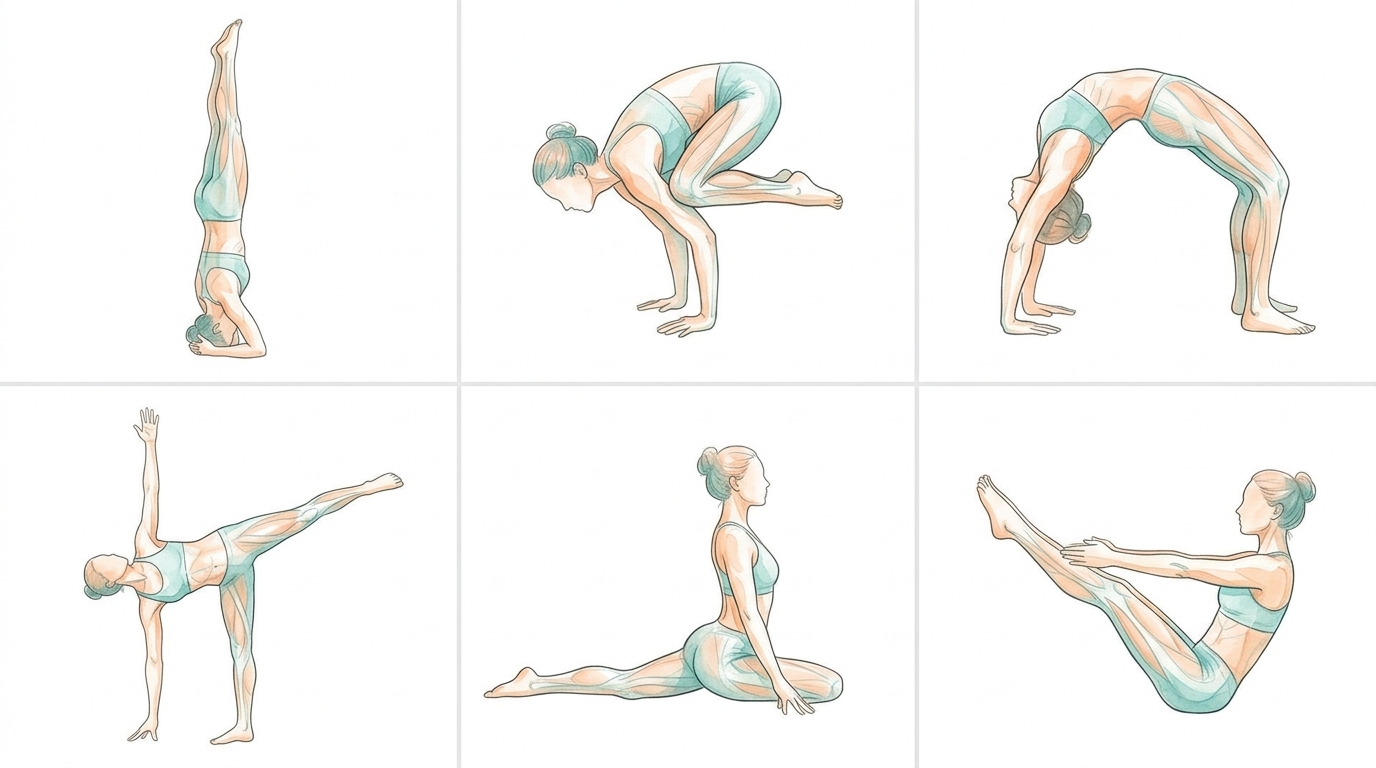
These poses build on your foundation. Each requires specific prerequisites โ don't rush.
Ardha Pincha Mayurasana
Sirsasana
Bakasana
Urdhva Dhanurasana
Ardha Chandrasana
The safest, most detailed headstand tutorial. Builds from forearm stand prep to full headstand over progressive stages.
12 minProgressive tutorial building from squat prep to full Crow. Learn the lean, the grip, and the lift.
10 minA complete 40-minute intermediate flow integrating balancing poses, backbends, and deeper stretches.
40 minYour daily meditation practice begins here. A gentle 10-minute guided session to build the meditation habit.
10 minBuild the shoulder and core strength needed for inversions. Practice Dolphin Pose daily. Start Headstand at the wall.
Dedicated Crow Pose drills 3x/week. Add Wheel Pose to backbend sessions. Introduce Trataka (candle gazing) meditation.
Hold Headstand away from wall. Complete Ashtanga through Navasana. Meditation sessions reach 20 minutes consistently.
Months 12โ18 ยท 5โ6x/week ยท 60โ90 min sessions
Goal: Master challenging poses, develop a personal practice (sadhana), and explore yoga philosophy deeply.
What advanced arm balances, handstands, and deep backbends permanently change in your kinetic chain:
Freestanding Handstands and Forearm Stands develop elite-tier serratus anterior and lower trapezius strength, creating permanent lifelong immunity against shoulder impingement.
Mastering Hanumanasana (splits) breaks down decades of stiff collagen cross-links in the posterior and anterior kinetic chains, restoring youthful fascial tensile elasticity.
Freestanding inversions teach the brain to stay calm while inverted without physical support, retraining the brain's innate panic circuits into grounded focus.
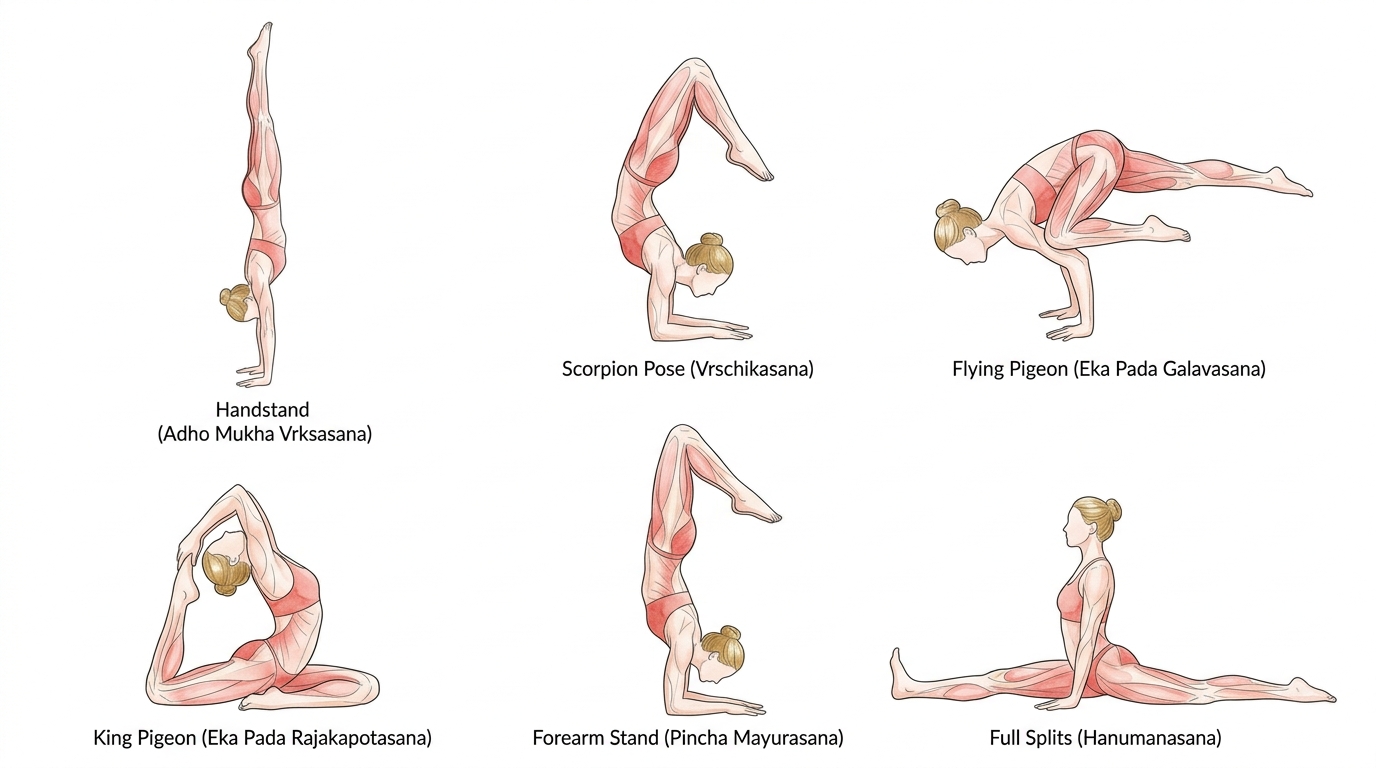
These poses require months of preparation. Focus on the journey, not the destination.
Adho Mukha Vrksasana
Parsva Bakasana
Hanumanasana
Pincha Mayurasana
From wall drills to freestanding handstand. The complete progressive training guide.
15 minA beautiful 45-minute advanced flow incorporating arm balances, deep backbends, and inversions.
45 minProgressive flexibility training to achieve full splits safely. Day-by-day stretching protocol.
20 minSeated meditation + intention
Nadi Shodhana or Kapalabhati
Sun Salutations A & B
Warriors, balances, twists
Arm balances / inversions
Folds, twists, hip openers
Complete stillness
Meditation & gratitude
Daily Handstand kick-up drills at the wall. Build to 30-second chest-to-wall holds. Shoulder tap drills for stabilization.
Begin designing your own sequences. Freestanding Handstand attempts daily. Hold Side Crow 15+ seconds each side.
Target 10-second freestanding Handstand hold. Transition between arm balances seamlessly. Bandha integration in all postures.
Months 18โ24 ยท Daily practice ยท 60โ120 min sessions
Goal: Integrate all 8 limbs, develop a teaching voice, explore subtle body practices.
The profound cellular, epigenetic, and spiritual impacts of daily sadhana and subtle body mastery:
Yoga Nidra and 45-minute daily meditation induce slow-wave delta and theta brain states, accelerating cellular DNA repair, reducing systemic inflammation markers (hs-CRP), and boosting immunity.
Advanced Pranayama with Kumbhaka (breath retention) trains cellular chemoreceptors to thrive in high-efficiency states, boosting tissue oxygenation via the Bohr effect.
Vipassana and self-inquiry decouple internal sensation from automatic emotional reactivity. You experience profound inner sanctuary regardless of external life turmoil.
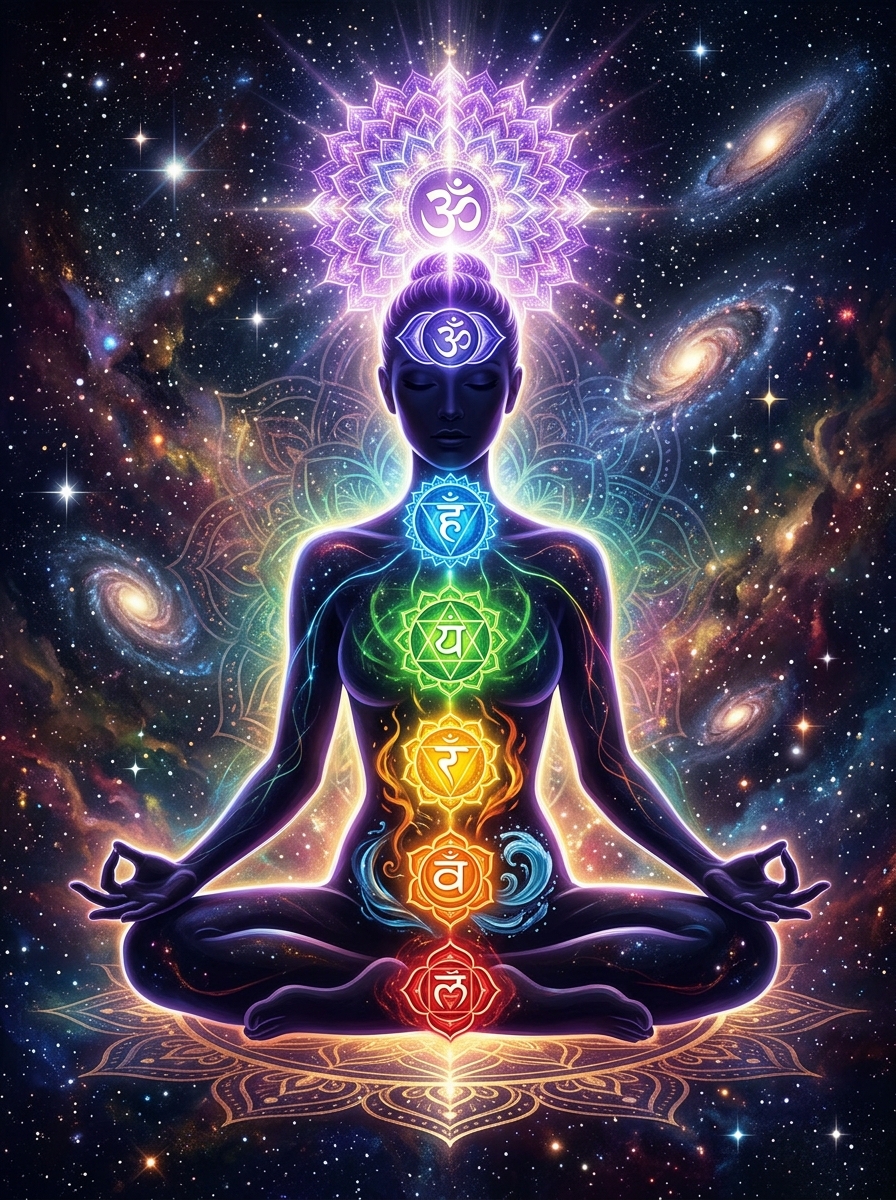
Understanding the chakras deepens your meditation practice and helps you work with energy during asana.
Insight meditation โ observe body sensations moment to moment without reacting. The deepest form of self-inquiry.
"Yogic sleep" โ a guided deep relaxation where you remain conscious while the body sleeps. Profoundly restorative.
Cultivating compassion by sending well-wishes to self, loved ones, neutral people, and all beings.
"Who am I?" โ Ramana Maharshi's method. The most direct path to understanding consciousness itself.
A 20-minute Yoga Nidra session. Lie down and follow the instructions for the deepest relaxation you've ever experienced.
20 minFollow along with the complete Ashtanga Primary Series led by a world-class practitioner.
75 minBhastrika, Surya Bhedana, advanced Kumbhaka. Build on your breathing foundation with powerful techniques.
18 minEstablish unshakeable morning practice (6 days/week). Daily meditation reaches 30 minutes. Study the Yoga Sutras of Patanjali and the Chakra System.
Introduce Kumbhaka (breath retention). Attend a 7โ10 day silent meditation retreat (Vipassana or similar). Deepen Bandha control.
Months 24+ ยท Daily self-practice + teaching
Goal: Share your practice, pursue formal certification, and deepen your lifelong relationship with yoga.
The lifelong cognitive and physical mastery achieved by teaching, mentoring, and continuous sadhana:
Simultaneously observing 15+ bodies, crafting real-time anatomical modifications, and verbally cueing complex sequences stimulates intense synaptic plasticity, protecting against age-related cognitive decline.
Holding safe space, offering gentle adjustments, and guiding others through vulnerability elevates oxytocin and vagal social engagement, shielding against modern isolation.
Your yoga evolves from physical performance into an effortless daily hygiene of breath, movement, and meditationโmaintaining pain-free mobility, posture, and joy across your entire life.
Registered Yoga Teacher (RYT-200). The foundational teacher certification covering asana, anatomy, philosophy, and teaching methodology.
4โ12 weeks intensiveExperienced Registered Yoga Teacher (E-RYT). Advanced study in sequencing, adjustments, and specialized topics.
6โ18 monthsPrenatal, Yin, Trauma-Informed, Kids Yoga, Yoga Therapy (1000+ hours), or Ayurveda integration.
OngoingClear verbal instructions for alignment โ "reach your right arm forward" not "reach that way"
Logical pose progression: warm-up โ peak pose โ cool-down. Build toward a "peak" in every class.
Read the room. Notice misalignment, fatigue, and emotional states without judgment.
Hands-on and verbal corrections. Always ask consent. Light touch > heavy push.
Offer 3 variations for every pose: easier, standard, advanced. Make yoga accessible to ALL bodies.
Create a safe, inclusive environment where students feel comfortable to explore and be vulnerable.
A world-renowned Ashtanga teacher shares her perspective on what true mastery means. Spoiler: it's not about poses.
8 minPractical advice on choosing a YTT program, what to expect, costs, and how to build a career in yoga.
14 minThe bible of yoga. Comprehensive pose encyclopedia with 600+ illustrations.
The core philosophical text of yoga with clear, accessible commentary.
Full-color anatomical illustrations of every major yoga pose.
The spiritual foundation of yoga. Essential reading for any serious practitioner.
How to develop a personalized practice. The best book on making yoga truly yours.
The definitive guide to the chakra system through the lens of Western psychology.
Begin or complete your 200-hour Yoga Teacher Training (YTT). Study anatomy, philosophy, sequencing, and hands-on adjustments daily.
Assist senior teachers in studio settings. Begin teaching 2โ3 public classes per week. Continue personal advanced sadhana.
Yoga is now your way of life. Regular retreat attendance, ongoing study with mentors, and selfless service (Karma Yoga).
Track your journey across all 6 phases. Progress is saved locally in your browser.